|
<< Click to Display Table of Contents > Visualization of Special Options |
  
|
|
<< Click to Display Table of Contents > Visualization of Special Options |
|
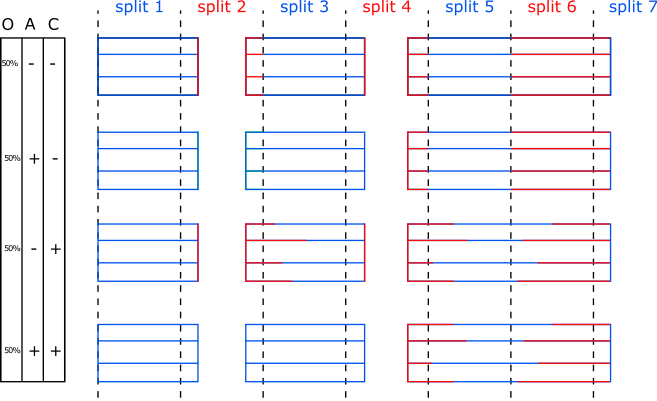
Figure 442: Visualization of Special Options, Split Overlap (O), Avoid unnecessary splits (A), Cog Vectors in Overlap Area (C)
For Fixed Size Splitting, a Split Overlap can be defined as a percentage (available for all split modes). Increasing the Split Overlap extends each split part in the positive split direction, creating an overlap with the following split part. Constant vectors whose end points lie entirely within the overlap area are included in the overlapping split part.
When Avoid Unnecessary Splits in enabled, vectors that begin within the overlap area may also be included in the overlapping split part, reducing unnecessary splits.
The example above illustrates the effect of different combinations of Split Overlap (O), Avoid Unnecessary Splits (A) and Cog Vectors in Overlap Area (C).
The vertical lines indicate the boundaries between the individual split parts, while the colored vectors represent the portions assigned to each split part. Orange and blue are used to distinguish consecutive split parts. For all rows a Split Overlap of 50 % is applied.
In the first row the overlap extends each split part into the following one, allowing vectors whose end points lie within the overlap area to remain in the split part in which they begin.
In the second row Avoid Unnecessary Splits was enabled additionally to the Split Overlap. As a result, vectors that begin within the overlap area are also assigned to the overlapping split part whenever possible, reducing the number of split vectors and potentially improving marking efficiency.
In the third row, Cog Vectors in Overlap Area is enabled instead. With this option the splitting of vectors is not done with a straight edge at the split boundary, but with a cogged edge. This distributes all split points across the overlap area.
The last row shows the combination of all options, where unnecessary vector splits are minimized and the remaining split vectors are divided using a cogged edge.